

A well-planned ride can make the first moments of a trip feel effortless. A Hawaii travel agent transportation partner helps connect clients with private, direct rides, flight-aware pickup planning, and flexible pickup and drop-off arrangements. The right fit also makes it clear how partner program enrollment works and what travel agents can expect from the relationship.
Flight schedules can change, and clients may have different arrival times, luggage, and destinations. A coordinated transportation plan helps avoid adding another loose end to the itinerary. Clear pickup instructions and a private ride can make arrivals smoother and give clients a more polished experience.
This guide explains how flight tracking can support pickup coordination, what private rides and flexible drop-offs can offer, and which details matter when arranging transportation for clients. It also covers partner program enrollment, so you can understand how a transportation relationship fits into your trip-planning process and where Luxor Transportation Hawaii’s private transportation services may be a natural addition.
Key Takeaways
- Match each ride plan to the client’s arrival schedule, destination, party, and luggage needs.
- Prepare the details travel partners typically need for enrollment and smooth trip coordination.
- Compare transportation options by island and itinerary, since routes and travel plans differ.
- Explore private airport transfers, chauffeur service, island tours, or corporate transportation when they fit the trip.
Pickup and drop-off flexibility
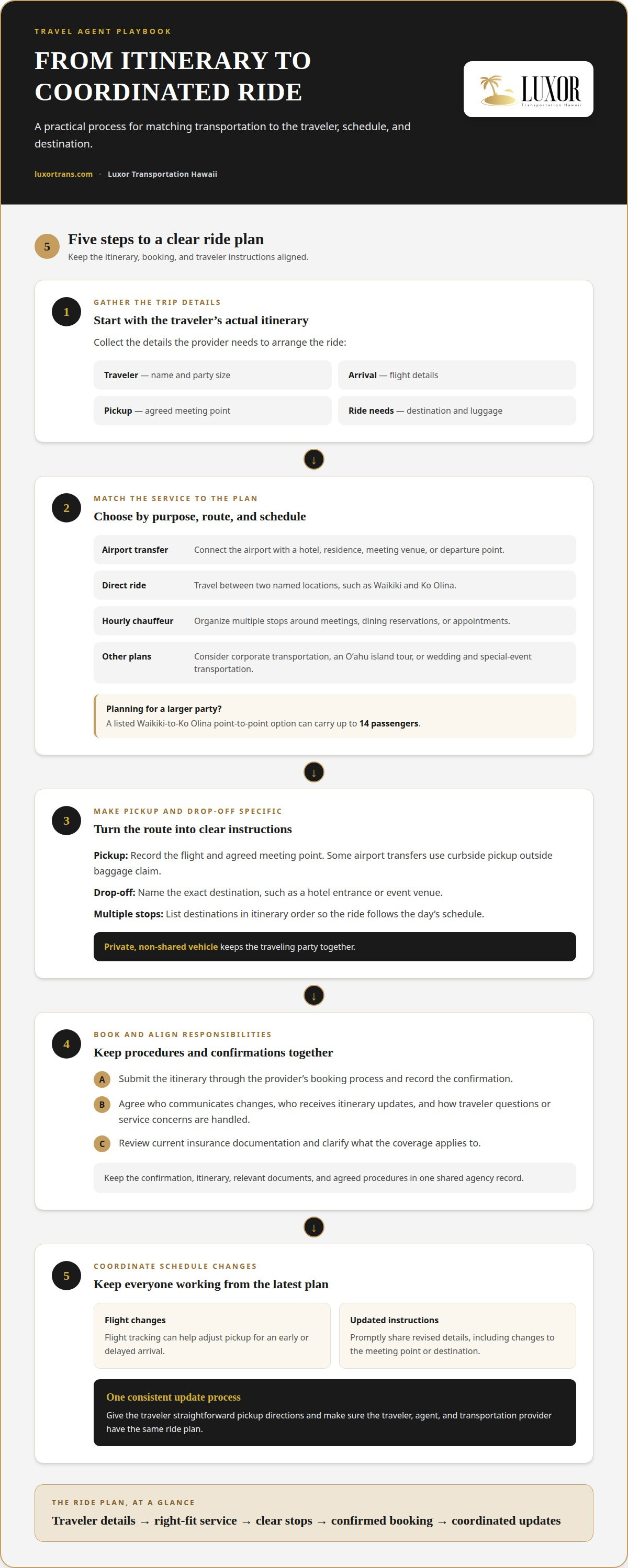
Start with precise pickup and drop-off details. Record the arrival flight, destination, and agreed meeting point, then match the ride to the traveler’s itinerary rather than relying only on the scheduled arrival time. A hotel check-in, business appointment, or tour can affect where and when the ride should end. Keeping these details together helps agents coordinate each handoff and set clear expectations.
Flight tracking can help adjust a pickup for an early or delayed arrival. Some airport transfers also use curbside pickup outside baggage claim, giving the traveler a defined meeting point. A private, non-shared vehicle keeps the traveling party together. These details can be useful when planning an arrival for a family, business group, or traveler with a full itinerary.
Make every pickup instruction specific. Share the flight information, identify the agreed meeting point, and give the traveler straightforward directions. For drop-off, provide the exact destination, such as a hotel entrance or event venue. If the itinerary includes several stops, list them in order so the ride follows the day’s schedule.
- Record the arrival flight, destination, and pickup point before finalizing instructions.
- Give travelers one clear meeting location, such as the agreed curbside pickup area.
- List each drop-off in itinerary order when a trip includes multiple destinations.
These steps also make schedule changes easier to communicate. If a flight arrives early or late, flight tracking can inform pickup adjustments. Share revised itinerary details promptly, including any change to the destination or meeting point. A consistent update process helps the traveler, agent, and transportation provider work from the same ride plan.
Travel agent partner program enrollment
Enrollment works best when both parties agree on booking procedures, communication, and responsibilities. A Hawaii travel agent transportation partner should fit the agency’s workflow and the traveler’s itinerary.
Insurance and Service Reliability
Before arranging transportation, review the provider’s current insurance documentation and clarify what its coverage applies to. Establish how reservations are confirmed, how schedule changes are communicated, and who handles service concerns. These practical details offer a clearer basis for evaluating the process than broad assurances. Keep relevant documents and agreed procedures with your agency’s partner records for easy reference.
Consider how communication works before and during a ride. Establish who receives itinerary updates and how travelers get their pickup instructions. When choosing a Hawaii travel agent transportation partner, review these procedures alongside the provider’s insurance information.
Client Booking and Coordination
To arrange a booking, collect the traveler’s name, flight details, pickup point, destination, party size, and luggage needs. Submit the itinerary through the provider’s booking process, record the confirmation, and give the traveler clear instructions. For a client with several appointments, provide destinations in sequence so the ride plan reflects the schedule.
Agree on who communicates changes and how updates reach the traveler. Keep the confirmation and itinerary in one shared record so agency staff can refer to consistent details. A Hawaii travel agent transportation partner arrangement works best when everyone understands how bookings, changes, and traveler questions will be handled.
Travel challenges can include shifting flight schedules, unfamiliar meeting points, and separate ground plans for different destinations. Give clients a simple update channel and identify the pickup location in plain language. For help organizing partner transportation procedures, use transportation partner information as a reference when planning your agency’s workflow.
What transportation services do Hawaii travel agents typically arrange for clients?
Build ground transportation around each itinerary’s purpose, arrival point, and schedule. For an arriving traveler, an airport transfer connects the airport with a hotel, residence, or meeting venue. For a departure, arrange the reverse route and share the pickup details with the traveler.
Private point-to-point rides suit clients who need a direct journey between named locations. On Oʻahu, a Waikiki-to-Ko Olina transfer illustrates how a route can connect a hotel district with a resort area. A listed version can carry up to 14 passengers. That capacity can help agents plan for a larger party while keeping everyone’s trip details together.
For itineraries with several stops, hourly chauffeur service can suit a client traveling between meetings, dining reservations, or appointments. Map the stops in order and use the itinerary to shape the ride plan. Corporate Transportation is another option for business travel when timing and destinations are important.
Leisure plans may call for an island tour rather than a single transfer. An agent can arrange an Oʻahu outing that fits the client’s preferred sights and schedule. Wedding and special-event transportation serves a different purpose, coordinating rides to a ceremony, reception, or other gathering. In each case, match the service to the occasion and communicate the plan clearly.
Before selecting an option, sort the itinerary by need:
- Airport arrivals: connect the airport with the first accommodation or scheduled destination.
- Direct transfers: link two locations, such as Waikiki and Ko Olina.
- Hourly service: organize multiple stops around a client’s day in Honolulu.
- Tours and events: coordinate transport around an Oʻahu outing or celebration.
This simple breakdown helps agents select transportation to suit the trip instead of treating every journey as the same kind of booking.
Which transportation options are available on Oahu, Maui, Kauai, and the Big Island?
Plan ground transportation separately for each island. Oʻahu, Maui, Kauaʻi, and the Big Island have distinct arrival points and itineraries, so organize each island’s rides around its airport, accommodation, and planned stops. A transfer on one island does not cover ground transportation on another.
Oʻahu has listed routes connecting Waikiki hotels with the North Shore and Leeward Coast, and Oʻahu hotels with Kualoa Ranch. The listed Waikiki-to-North Shore and Leeward Coast transfer can carry up to 14 passengers. The Oʻahu Hotels-to-Kualoa Ranch transfer also carries up to 14 passengers. These examples help agents consider party size when planning a group itinerary.
On the Big Island, KOA serves as a clear example of an airport-to-resort connection. A private round-trip transfer from KOA to Waikoloa Resorts is listed as taking 45 minutes. For North Waikoloa Resorts, a listed private round trip takes 50 minutes to 1 hour 10 minutes. Keep the island, airport, and resort destination together in the itinerary to distinguish this ride from Oʻahu transportation.
For Maui and Kauaʻi, start with the traveler’s arrival airport, lodging location, and scheduled activities. Organize transportation around those specific points rather than carrying an Oʻahu route plan across islands. For a multi-island vacation, make a separate ride plan for each island and align it with the traveler’s flight and accommodation details.
- Oʻahu: match routes such as Waikiki to the North Shore or Kualoa Ranch to the group’s plans.
- Big Island: distinguish KOA-to-Waikoloa and KOA-to-North Waikoloa destinations.
- Maui and Kauaʻi: structure each itinerary around its own airport, lodging, and activities.
For help shaping a private Oʻahu itinerary around your clients’ plans, plan island transportation.
Luxor Transportation Hawaii: Airport Transfer Service
Luxor Transportation Hawaii can help travel agents arrange private transportation for clients arriving on Oʻahu. Its Airport Transfer Service suits airport-to-destination trips, while Hourly Chauffeur Service can support itineraries with multiple stops. For leisure plans, Island Tours offer a way to incorporate transportation into an Oʻahu outing. Corporate Transportation can serve clients traveling for business.
Choose the service that matches the trip: an airport connection, a day with multiple stops, a tour, or business transportation. Share the client’s itinerary and destination details when arranging the ride so the plan reflects the trip’s needs.
For your clients’ Oʻahu transportation, contact Luxor Transportation Hawaii to arrange the service that fits their itinerary.
Build a More Seamless Guest Journey
Make transportation part of itinerary planning, not a last-minute detail. A coordinated ride connects arrival plans with the experience your client came to enjoy. If you are looking for a Hawaii travel agent transportation partner, discuss how Luxor Transportation Hawaii’s Honolulu Airport Transfer, Private Car Service, and Oahu Island Tours can fit the trips you arrange.
Consider where coordinated ground transportation matters most: the first ride after landing, a day with several stops, or a planned island outing. Matching the service to each client’s itinerary gives you a clear starting point for arranging the ride.
Contact Luxor Transportation Hawaii to discuss transportation for your clients’ Oʻahu plans. A well-planned journey starts with a thoughtful next step.
Frequently Asked Questions
Which Hawaii transportation companies partner with travel agents and tour operators?
Transportation companies offering private transfers, chauffeur service, or tours may suit travel-agent coordination. Luxor Transportation Hawaii offers Airport Transfer Service, Hourly Chauffeur Service, Island Tours, and Corporate Transportation. Those offerings can fit different itinerary needs, but they don’t by themselves establish a formal partner arrangement. Agents should distinguish between booking a service for a traveler and enrolling in an agreed partner program.
How can a travel agent become an authorized transportation partner in Hawaii?
Start by contacting the transportation company and asking about its agent partnership process. Share your agency details, the kinds of trips you arrange, and how you expect to book and coordinate rides. Before describing yourself as an authorized partner, get the company’s approval and any agreed terms in writing. This makes the relationship and permitted use of its name clear to your team.
What are the requirements for Hawaii transportation companies to work with travel agencies?
Set out the practical details your agency needs: what information to provide, how bookings are submitted, who handles itinerary changes, and what confirmation the company provides. For example, an agency arranging transfers for a corporate group will benefit from a clear process for sharing schedule updates. Agree on responsibilities and keep the procedures accessible to staff handling client travel.
How do travel agent commissions and partner rates work for Hawaii transportation providers?
Any commission or partner-rate terms should be established directly between the agency and transportation provider. Do not assume a commission applies or that a partner rate is available. Clarify how compensation is calculated, when it is paid, and how cancellations or booking changes affect it. Record whether the traveler pays the provider directly or the agency collects payment, and follow the agreed process for each booking.


