

A conference transportation plan should follow the attendee schedule, not force it into a vehicle’s limits. For organizers managing group transportation for hawaii conference, the challenge is connecting staggered arrivals, conference movements, and departures while keeping every pickup clear. When session times change or executive guests need a more tailored experience, a thoughtful plan helps the day feel composed rather than rushed.
Start by identifying when each group needs to move, where they will meet, and which destinations are on the agenda. Then match the vehicle arrangements to those movements, account for different arrival times, and keep the plan current as conference details evolve.
This guide walks through the process, from mapping airport pickups and venue transfers to organizing departures. You’ll also learn how Luxury Sedans, Mercedes Sprinter Vans, and Cadillac Escalade ESVs can fit different travel patterns. Luxor Transportation Hawaii’s Corporate Transportation service brings professional chauffeurs trained in safety, etiquette, and local knowledge to conference travel, with the company’s “Luxury Ground Transportation with Island Hospitality” approach.
Key Takeaways
- Start with attendee groups, agenda times, and destinations to build a movement plan around the conference rather than forcing the schedule to fit vehicles.
- When managing group transportation for hawaii conference, map each pickup and destination clearly so attendees know where to go and coordinators can track each movement.
- Compare shared, executive, and mixed travel patterns to choose vehicle arrangements that suit each itinerary.
- Use separate pre-event, arrival-day, conference-day, and departure checks to keep instructions, itinerary versions, and coordinator responsibilities aligned.
- See how Luxor Transportation Hawaii’s Corporate Transportation service can support conference travel with professional chauffeurs.
Why Group Transportation Can Make or Break a Hawaii Conference Schedule
A conference planner has two schedules to protect: the program attendees came for and the movements that get them there. Transportation should support the event, not pull organizers away from sessions to resolve missed pickups or unclear directions. That takes more than assigning vehicles. Organizers need to know when each group moves, where it meets, and how an agenda change affects the plan.
Arrival windows, session start times, and departure plans create different transportation needs. Guests arriving at different times may need separate pickup arrangements, while attendees leaving a scheduled session together may share a departure. Departures add details of their own, including each traveler’s pickup time and destination. Treating every movement as one general transfer can leave gaps in the day.
Conference transportation planning is the schedule-led coordination of people, vehicles, pickup points, and destinations across every planned movement. This practical definition reflects the broader principles of transportation planning: coordinate movement around the people and activities the plan is meant to serve. For organizers, that means building transportation into the event agenda instead of treating it as a last-minute add-on.
Which conference movements need a transportation plan?
Divide the itinerary into three movement types: arrival transfers, scheduled conference movements, and departure transfers. For each one, record the pickup point, destination, time or time window, attendee group, and coordinator responsible for sharing instructions. Mark whole-group travel separately from executive or VIP itineraries, which may follow different schedules. Include optional activities only when they are on the confirmed agenda, so the transport plan reflects actual commitments.
This movement-by-movement view shows where plans overlap and where they need to stay separate. A group may travel together between scheduled sessions, while an executive follows a different sequence. Listing each movement gives organizers a clear view of the requirements without assuming that every attendee follows the same route.
What makes group transportation challenging?
Staggered arrivals rarely work like one coordinated departure. Attendees can arrive at different times, receive different instructions, and need pickups that reflect their own schedules. A group leaving a session together may have a shared departure window instead. Plan these as distinct movement patterns, with pickup details tailored to each group.
Agenda changes can affect several details at once: vehicle timing, pickup points, and instructions already sent to attendees. Maintain one current source of truth for transportation information, such as a controlled itinerary shared with coordinators and matching attendee directions. Assign one person to update both when plans change. Otherwise, organizers may spend event time resolving conflicting instructions. Each set of directions should state where to meet, when to be ready, and whom to approach for help.
How to Turn a Conference Agenda into a Group Transportation Plan
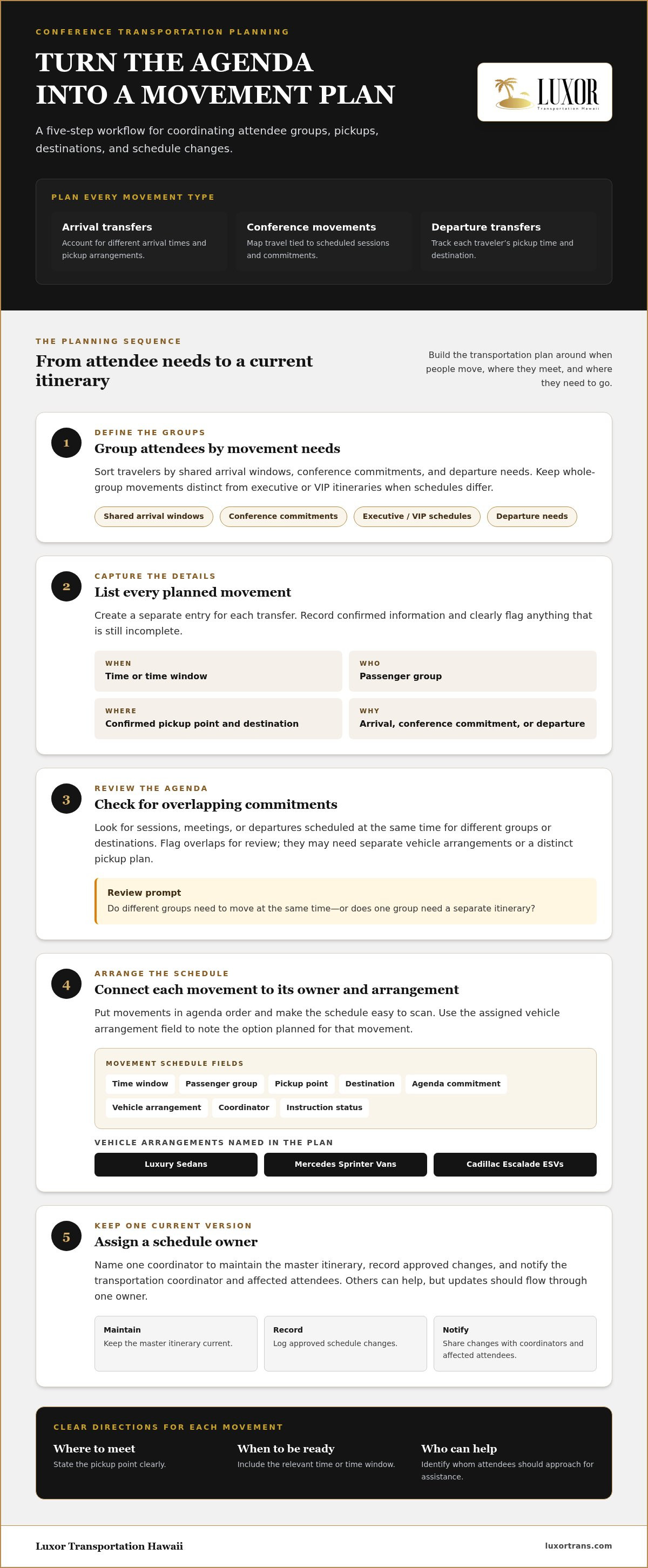
Begin with the agenda, then translate each attendee movement into a clear transportation requirement. This gives planners and transportation coordinators a shared framework for arranging vehicles, communicating pickup details, and handling approved changes. A step-by-step workflow keeps the details visible and helps prevent assumptions from becoming instructions.
- Group attendees by movement needs. Sort travelers by shared arrival windows, conference commitments, and departure needs. Separate group movements from executive or VIP itineraries when their schedules differ. Use the agenda and traveler information to define groups, rather than guessing who will travel together.
- List each planned movement. For every transfer, record its time or time window, passenger group, confirmed pickup point, and destination. Note the purpose, such as arrival, a conference commitment, or departure. Keep unconfirmed details clearly marked as incomplete.
- Check the agenda for overlaps. Look for sessions, meetings, or departures scheduled at the same time for different groups or destinations. Flag each overlap for review. It may require separate vehicle arrangements or a distinct pickup plan.
- Build the transport schedule. Arrange movements in agenda order. Connect each movement to its pickup point, destination, assigned group, and the person responsible for communicating instructions. Make the schedule easy to scan so coordinators can spot missing details before the event.
- Assign a schedule owner. Name one coordinator to maintain the master itinerary, record approved changes, and notify the transportation coordinator and affected attendees. Other team members can help, but updates should flow through one owner to avoid conflicting versions.
Build the schedule from attendee movements
A planning table can use one row for each movement, with columns for time window, passenger group, pickup point, destination, agenda commitment, assigned vehicle arrangement, coordinator, and instruction status. Fill in confirmed details and mark anything still outstanding. This makes it easy to see which movements are ready and which need follow-up, without inserting invented times, locations, or attendee counts.
Keep overlapping items separate instead of combining them into a broad entry. For example, if two attendee groups have different commitments at the same time, give each movement its own row. Coordinators can then compare pickup points and destinations before sharing the schedule.
Keep the plan clear as details change
Maintain one current itinerary for organizers and transportation coordinators. When an approved agenda change affects a pickup, the schedule owner should update the master version, identify affected travelers, and send revised instructions through the event’s chosen communication channel. Make the latest version easy to recognize and retire outdated copies so attendees aren’t left comparing conflicting directions.
For executive travel considerations alongside the conference schedule, see this executive car service planning guide. Keeping the agenda and transportation plan aligned also helps organizers plan a polished corporate travel experience. Learn about corporate transportation with Luxor Transportation Hawaii as you map the event’s movements.
Matching Conference Groups and Itineraries to Vehicles
Choose vehicle arrangements based on how attendees need to travel, not just the total number registered for the conference. Some movements bring a group to the same commitment; others involve executives with separate arrival times or individual schedules. A mixed plan can accommodate both patterns. For organizers managing group transportation for hawaii conference, match each assignment to the actual itinerary and confirmed passenger details.
Luxor Transportation Hawaii’s fleet includes Luxury Sedan, Cadillac Escalade ESV, and Mercedes Sprinter Vans. Use the table as a planning framework, not a capacity chart. It connects common travel patterns to vehicle categories without assuming passenger limits, luggage space, or other specifications.
| Travel pattern | Planning priority | Relevant confirmed vehicle category |
|---|---|---|
| Shared movement for a conference group | Align pickup and destination with the group’s scheduled commitment; use actual passenger details when planning. | Mercedes Sprinter Vans |
| Separate executive or VIP travel | Account for individual arrival times, destinations, and meeting schedules. | Luxury Sedan or Cadillac Escalade ESV |
| Mixed group and individual itineraries | Keep shared movements distinct from separate executive assignments, even when they overlap. | Mercedes Sprinter Vans, Luxury Sedan, or Cadillac Escalade ESV, according to the itinerary |
When does a conference plan call for separate vehicle arrangements?
Separate arrangements can help when attendees arrive at different times, have distinct destinations, or follow individual meeting schedules. An executive or VIP itinerary may need a different pickup plan from the main conference group. Base the assignment on actual movements and timing, not assumptions about status. Luxor Transportation Hawaii provides Corporate Transportation for corporate and VIP clients, with professional chauffeurs trained in safety, etiquette, and local knowledge.
A Luxury Sedan or Cadillac Escalade ESV may suit a separate itinerary, depending on the confirmed schedule and passenger details. Identify each movement clearly, including who is traveling, where pickup will take place, and the destination. That helps coordinators avoid treating an individual schedule as an extension of the group’s transfer.
When can a van support coordinated group movement?
Mercedes Sprinter Vans are a fleet option for group transportation. They can be included in planning when attendees share a pickup and destination as part of a coordinated movement. Base the assignment on actual passenger counts and itinerary details. Don’t infer seating capacity, luggage limits, or amenities; tie the decision to the group’s documented requirements.
For broader context on corporate travel and service considerations, explore this luxury transportation services guide. A vehicle plan matched to the schedule helps organizers keep group movements and individual assignments clear.
A Conference Transportation Checklist for Before and During the Event
A polished transportation plan needs more than a schedule. Attendees need instructions they can follow, coordinators need clear responsibilities, and everyone involved needs the same current information. For organizers managing group transportation for hawaii conference, a staged checklist helps keep preparation and event-day decisions orderly as agenda details change.
The essential planning inputs are attendee groups, movement times, pickup points, and destinations. Keep them together in a master itinerary and label its current version so organizers can distinguish approved updates from outdated copies.
Pre-event checks
Before conference travel begins, compare the transportation plan with the latest confirmed agenda. Assign an owner for the master itinerary and name the organizer responsible for communicating changes. Agree on how the event team and transportation coordinators will share routine updates and handle urgent schedule questions.
- Review each movement against the current agenda and attendee groups.
- Prepare instructions with the relevant pickup time, meeting point, destination, and coordinator contact procedure.
- Share itinerary updates with the people coordinating transportation, and mark the current version clearly.
Arrival-day checks
On arrival day, use the agreed itinerary to help each traveler find the pickup details for their movement. Give each group specific instructions instead of relying on one broad message that may not fit everyone’s schedule. The coordinator can record questions or changes and route them through the established organizer channel to keep decisions and communications consistent.
Conference-day checks
During the event, the on-site coordinator should compare upcoming group movements with conference transitions. If an agenda change is approved, identify which pickups, destinations, and attendee instructions it affects. Then update the master itinerary and communicate the revision to those affected through the agreed channel. This is a deliberate review process, not a promise of real-time vehicle tracking or automatic updates.
- Review upcoming movements against the latest approved agenda.
- Share only approved changes, and make clear which instructions they replace.
- Keep a record of the current version and who is responsible for the next update.
Departure checks
Before departures, compare pickup instructions with the final attendee schedule. Confirm that each traveler or group has the right time, meeting details, destination, and contact procedure. If arrangements change, send revised instructions to affected attendees and coordinators through the agreed channel. Attendees should know whom to approach, and the team should know who can approve a change.
A concise checklist gives coordinators a practical reference throughout the event. Learn about corporate transportation with Luxor Transportation Hawaii as you prepare the movement plan.
Plan Conference Ground Transportation with Luxor Transportation Hawaii
A conference schedule deserves ground transportation planned with the same care. Luxor Transportation Hawaii’s Corporate Transportation service helps organizers shape travel around the agenda, attendee groups, and pickup details. The plan can account for shared movements as well as individual executive or VIP itineraries.
What Luxor Transportation Hawaii brings to corporate travel
Luxor Transportation Hawaii serves corporate and VIP clients with professional chauffeur service and a fleet that includes Luxury Sedan, Cadillac Escalade ESV, and Mercedes Sprinter Vans. Organizers can match these vehicle options to each movement on the schedule, using the travel pattern, attendee group, and confirmed itinerary details rather than assumptions about capacity or vehicle specifications.
Professional chauffeurs are trained in safety, etiquette, and local knowledge. Their professional presence helps create a welcoming, polished experience from one scheduled movement to the next. Luxor Transportation Hawaii reflects its tagline, “Luxury Ground Transportation with Island Hospitality,” and its mission, “Delivering excellence with aloha.” The focus is attentive transportation that complements the occasion without distracting from the reason attendees have gathered.
For executive and VIP travel, the plan can account for individual schedules alongside the broader conference itinerary. A separate arrival or meeting movement can be planned on its own terms, while shared group travel remains connected to the event agenda. Keeping these patterns distinct gives organizers a clear basis for arranging transportation around actual needs instead of applying one approach to every traveler.
What details help shape a conference transport request?
Prepare the information that shows how attendees will move throughout the event. Start with attendee groups, the latest agenda, the movement schedule, and confirmed pickup details. Include destinations, the timing or time windows for each movement, and any differences between shared group travel and executive or VIP itineraries. If details are still being finalized, label them in the working plan so assumptions don’t appear as settled arrangements.
The closer the transportation plan follows the conference itinerary, the easier it is to see how arrivals, scheduled movements, and departures fit together. Use the agenda to identify which guests move together, which need separate arrangements, and where instructions should be tailored to a particular group. This creates a practical foundation for planning Corporate Transportation around the event.
Ready to shape ground transportation around your conference schedule? Plan your conference transportation with Luxor Transportation Hawaii.
Set Your Conference Transportation Plan in Motion
Make the transportation plan useful before it becomes a stack of separate notes, messages, and last-minute decisions. Turn the working itinerary into a clear brief the event team can act on, and decide who will own updates as the conference approaches. This gives planners a practical starting point for managing group transportation for hawaii conference while keeping the attendee experience in view.
As you prepare the brief, focus on the details that shape each movement and the people who need to act on them. A shared understanding of the plan helps your team make considered decisions as the event takes shape, without losing sight of its priorities. Well-planned transportation lets attention stay on the conference and its guests.
Bring your schedule and transportation needs together with Luxor Transportation Hawaii. Plan your conference transportation with the company’s professional chauffeurs and fleet of Luxury Sedan, Cadillac Escalade ESV, and Mercedes Sprinter Vans.
Frequently Asked Questions
How do you plan transportation for a conference group?
Align each trip with the conference program and the people making that movement. Start with arrival, event, and departure needs, then look for pinch points such as overlapping sessions or groups heading to different destinations at the same time. For managing group transportation for hawaii conference, consider how a delay in one movement could affect the next, and make responsibilities clear before attendees begin traveling.
What information should I prepare for a conference transportation plan?
Prepare the agenda, attendee groupings, trip times, pickup instructions, destinations, and a named planning contact. For airport arrivals, include relevant arrival details and the traveler or group associated with each pickup so coordinators can distinguish one movement from another. Note which details are final and which are still being settled. This helps the team work from accurate information without treating an assumption as a confirmed instruction.
How many vehicles does a conference group need?
There’s no single vehicle count that suits every conference. Base the plan on actual passenger numbers for each movement, the number of simultaneous trips, and whether groups share a destination and schedule. Don’t calculate from total registration alone: not everyone may travel at once, and some guests may have separate itineraries. Match each assignment to the documented movement and vehicle arrangement rather than assuming a specific capacity.
Should conference attendees travel together or in separate groups?
Have attendees travel together when they share a pickup, destination, and schedule; use separate arrangements when arrival times or commitments differ. A mixed approach can coordinate a scheduled group movement while accommodating executives or VIP guests with individual itineraries. For example, a traveler with a separate meeting may need a distinct plan rather than a departure tied to the full group. Let the agenda guide the choice.
How can conference organizers handle last-minute schedule changes?
Use a simple change process: have one designated organizer approve the revision, update the current itinerary, identify affected trips, and send corrected directions to the attendees and coordinators involved. State what changed and which previous instruction it replaces. Keep an accessible record of the current version so staff don’t act on outdated details. For changes affecting multiple groups, review each impacted movement before communicating the revised plan.
What vehicle options are available for conference transportation?
Luxor Transportation Hawaii’s fleet includes Luxury Sedan, Cadillac Escalade ESV, and Mercedes Sprinter Vans. Organizers can consider these for individual executive travel, mixed itineraries, or coordinated group movements. Choose based on actual passenger details and travel patterns, not an assumed seating capacity or luggage limit. A clear itinerary connects each vehicle assignment to the movement it is intended to serve.


